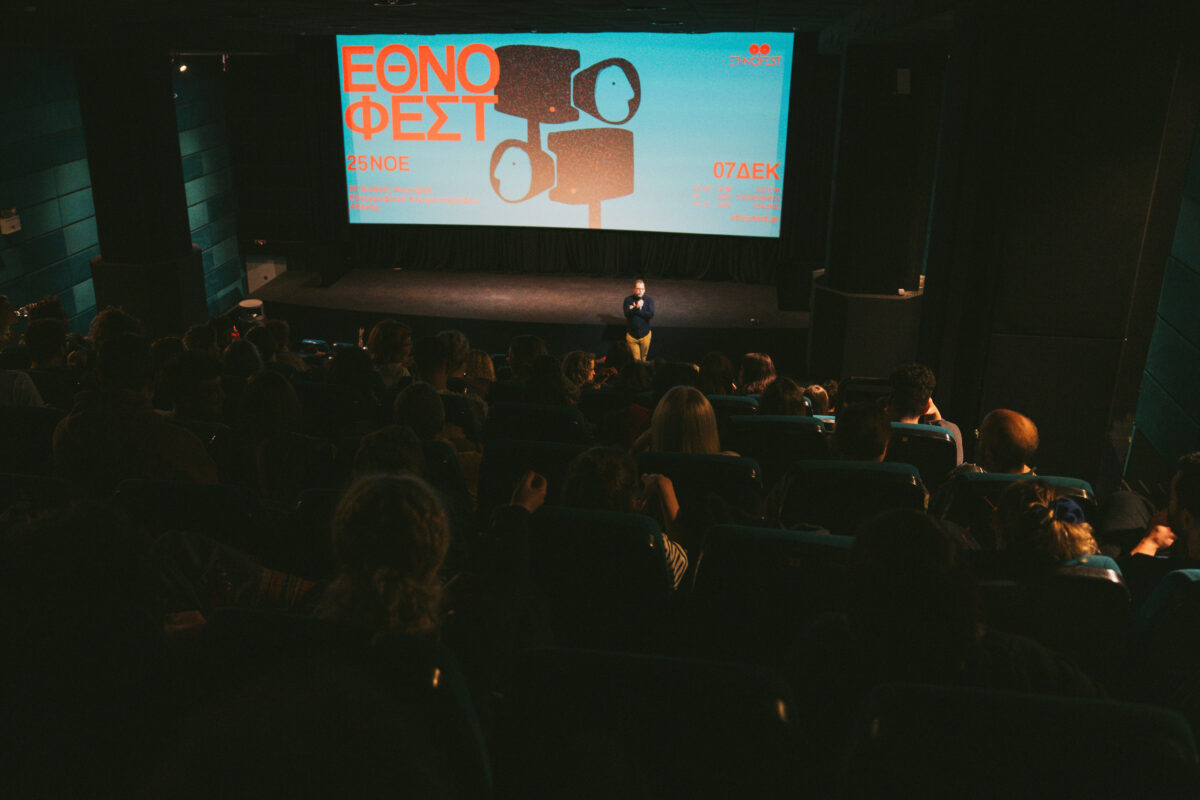
The 16th Ethnofest – Athens International Ethnographic Film Festival has been successfully completed, receiving a warm response from the public, with more than 2,000 viewers attending screenings at the Astor Cinema until December 1, and online until December 7.
This year’s edition marked the first time that the section “Initiations: Student Films in Greece” assumed a competitive format. The Jury, consisting of Panos Gkenas, Mel Kalfantis, and Fili Olsevski, awarded a Special Mention to The Café Will Remain Closed by Magda Alexandri and Anna Chrysanthakopoulou, while the Best Film Award was given to Taratsa by Dimitra Chrysoula.
The filmmakers received their awards in an atmosphere of emotion, mutual support, and pride. As a tangible form of support for emerging cinematic voices, the award was accompanied by a €500 cash prize. Throughout the festival, international and Greek student films filled the Astor cinema, creating a vibrant community of dialogue, exchange, and interaction beyond the confines of academia.
One of the central meeting points and defining features of this year’s Ethnofest was the tribute “Geographies of the Gaze: Off-Plan Greece (1950–2000)”, presented in collaboration with the Thessaloniki International Film Festival. The tribute opened a window onto rare and hard-to-access films deeply connected to the Greek countryside and to a sense of Greekness “off the grid.” Originally presented at the 27th Thessaloniki Documentary Festival, the tribute found its ideal context at the 16th Ethnofest, introducing Athenian audiences to these works. The curators Eleni Androustsopoulou, Manolis Kranakis, and Yannis Palavos welcomed the viewers and spoke about the process of shaping the tribute, starting from Kastoria and Takis Kanellopoulos’ “Macedonian Trilogy,” as well as the challenges and importance of the filmmakers and their work. Within the framework of the tribute, we were honored to host filmmakers Dimitris and Kostas Koutsiabassakos, Manos Efstratiadis, and Christos Voupouras. The tribute concluded the festival on Monday, December 1, with a free and fully accessible screening at the Greek Film Archive.
Another particularly significant event was the screening of the documentary Unmaking Of, addressing art in the midst of genocide, accompanied by an intervention from the Filmmakers for Palestine network. Among the guest filmmakers was Philip Cartelli, who presented Ashes of Time for the first time as a work in progress, as part of the section Narrating the Fieldwork – a platform where audiovisual projects in development receive framing, support, and professional feedback. Additionally, directors Isabelle Ingold and Vivianne Perelmuter returned to Ethnofest for the third time with their new documentary New Beginnings.
Reshaping Ethnofest
The festival in the form we have known until now has completed its course.
It was a living and meaningful event, and, as demonstrated by the strong participation of both filmmakers and audiences, deeply connected to what has always defined Ethnofest: a meeting place for documentaries that require time, care, and dialogue.
After 16 years of creative festival-making, this year’s edition marks the completion of an important cycle. On the opening night, we shared a decision that has been maturing for some time: the festival, in its current form, reaches its conclusion.
This decision does not stem from a sense of withdrawal. On the contrary, it arises from a deep awareness of what we have accomplished and from the need to protect and evolve our core mission. The festival, along with the International Summer School and our educational and developmental activities, constitutes a pioneering and unique proposition within both the Greek and international documentary landscape – one we do not wish to see stagnate through repetition.
Observing shifts in the funding landscape as well as in the broader cultural ecosystem of Athens, we recognize a growing saturation of cultural and film events drawing from the same funding sources and addressing similar audiences. Especially during the final quarter of the year, Athens is filled with festivals. This is not a commentary or comparison, but a sincere assessment of the complex reality in which we operate, taking into account other interlocutors in this ecosystem such as funding, media, film distribution, and more.
Within this context, it is necessary to take a step back and allow space to explore new, fresher, and more sustainable forms of cultural intervention, better suited to highlighting our distinct content and objectives.
Our founding purpose remains non-negotiable: to create spaces and time for documentaries, for new, daring, and pioneering voices, and to bridge the academic and cinematic fields. So does our conviction that Ethnofest should be more than a festival, something we have already achieved. Ethnofest remains a platform for dialogue, education, exchange, and meaningful connection with the communities and stories that deserve to be heard.
From the coming year onward, we will be developing new forms of presence and engagement in the city of Athens – forms that will allow us to connect more deeply with residents, creators, and active citizens, and to engage creatively and dynamically with the contemporary cultural landscape.
Very soon, we will announce our first new activity beyond the Summer School: an initiative dedicated to supporting and showcasing student films produced across film and social science departments worldwide, with a continued focus on ethnographic approaches and socially engaged documentary filmmaking.
Ethnofest doesn’t say goodbye; it evolves.
We move forward with the same belief in the power of documentary, the necessity of collective spaces for viewing and reflection, and the certainty that stories that matter always find a way to be told.
Stay connected for what comes next.
More information & announcements: www.ethnofest.gr
Contact: [email protected] | [email protected]
The 16th Ethnofest – Athens International Ethnographic Film Festival was held with the support of the Hellenic Film and Audiovisual Center – Creative Greece (EKKOMED) and the Directorate of Modern Cultural Heritage of the Ministry of Culture.